
Seller concessions vs price reduction: Which one saves you more? A lower price usually reduces the loan balance a little. A seller credit may lower the cash you need at closing or fund an eligible rate buydown. The better choice depends on your down payment, loan program, appraisal, and how long you expect to keep the loan.
Consider a $600,000 home where the seller is willing to improve the deal by $15,000. You could ask for a $15,000 price reduction, a $15,000 credit toward eligible closing costs, or a mix. Those options are not economically identical, and a credit cannot simply become cash in your pocket.
Colorado market update: why waiting for lower rates is not your only option
Market context reviewed October 10, 2026; the figures below describe August 2026.
If higher mortgage rates have you sitting on the sidelines, take a closer look at what you can negotiate today. The Colorado Association of REALTORS® September market report describes slower demand and longer selling times giving buyers more negotiating power. Its Denver commentary reports that nearly 46% of August closings involved a price reduction and 61% included concessions. That does not mean every seller will say yes, but it does show that negotiating help with your purchase is a real opportunity.
For a buyer with stable income, enough savings and a comfortable budget, now can be a good time to buy. A motivated seller may consider a lower price, a credit toward your costs, or both. Your agent can look for longer days on market, previous price cuts and competing listings, then negotiate an offer that fits the property. Prices and seller motivation vary by neighborhood and home; a statewide trend does not establish the right offer for a specific listing.
Waiting for rates to fall has trade-offs. If lower rates bring more buyers back, competition could increase and concessions could become harder to negotiate. That is a possibility, not a forecast. Compare the home and financing available today with the cost and uncertainty of waiting, using our buy now or wait guide.
What does a $15,000 price reduction do?
If you put 20% down, lowering the price from $600,000 to $585,000 reduces the down payment by $3,000 and the loan amount by $12,000. At a hypothetical 6.5% 30-year fixed rate, the principal-and-interest payment would fall by about $76 per month. You may also save on transfer-related costs or taxes, but those effects vary. The appraisal and contract terms still have to support the price.
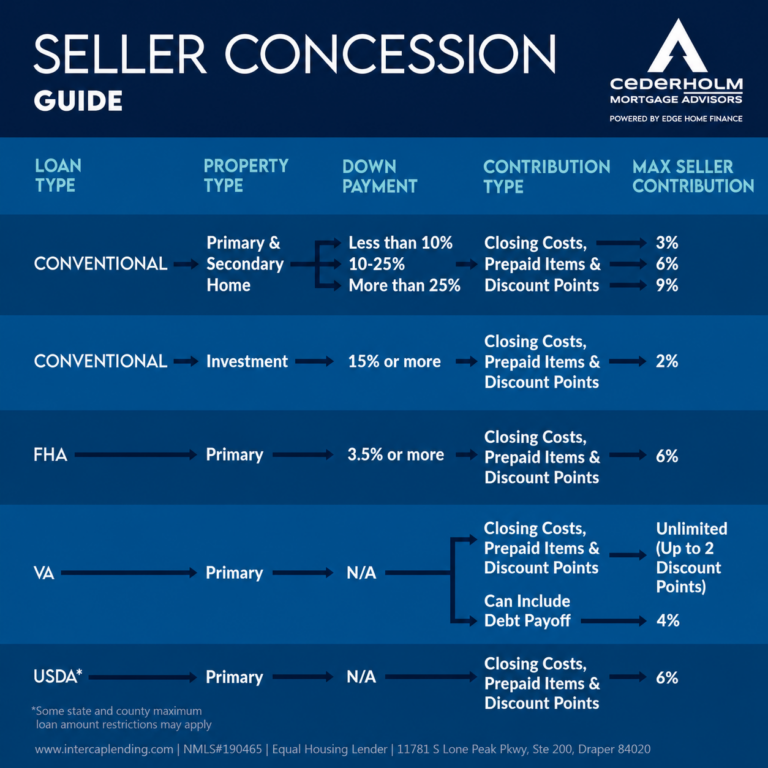
The original infographic is a quick illustration. Use the updated program table below for current limits and the VA distinction between ordinary closing costs and defined seller concessions.
What does a $15,000 seller credit do?
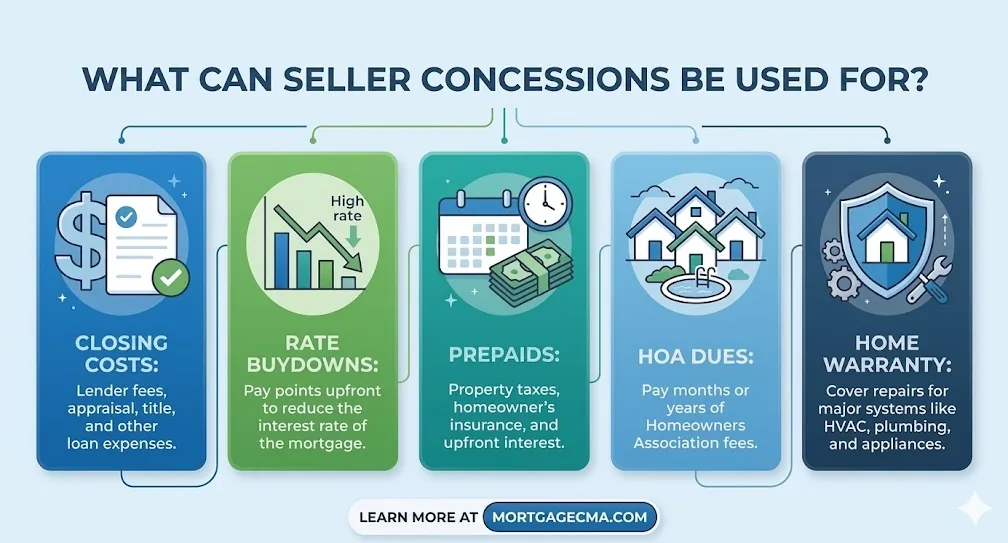
A credit can pay eligible buyer closing costs and prepaid expenses, subject to the loan program’s limits and the actual costs charged. It may help a buyer keep more savings after closing. Some credits can fund discount points to lower the permanent rate; others may fund a temporary buydown. Ask your lender to model both options, because the benefit and break-even period are different.
For conventional loans, Fannie Mae’s interested-party contribution rules set caps based on occupancy and loan-to-value ratio. For an owner-occupied or second-home purchase, the usual caps are 3% above 90% LTV, 6% from 75.01% to 90% LTV, and 9% at or below 75% LTV; investment properties are capped at 2%. Those are maximums, not an entitlement. Other loan programs have their own rules, and credits generally cannot exceed eligible costs.
How seller concessions can help in today’s higher-rate environment
A seller credit can help you lower the rate on an eligible mortgage through discount points, reduce your early payments through a temporary buydown, or preserve savings by paying closing costs. An adjustable-rate mortgage is another loan option to compare. These choices solve different problems, so ask us to show cash to close, the initial payment, later payments and total costs side by side.
Temporary rate buydowns: lower payments for the first few years
With an approved 2-1 buydown, the seller funds a subsidy at closing. Your portion of the principal-and-interest payment is calculated using a rate two percentage points below the note rate in year one and one point below it in year two. Starting in year three, you pay the full note-rate payment. A 1-0 or 3-2-1 structure may also be available, depending on the loan program and lender.
A temporary buydown does not change the mortgage’s contractual note rate. It uses prepaid funds to supplement your early payments. On an eligible fixed-rate loan, the scheduled step-ups are known in advance. Fannie Mae requires qualification at the note rate, without using the subsidized rate. Review the full payment before choosing this option and read the agreement for how unused funds are handled if you sell or refinance early. See Fannie Mae’s temporary buydown rules.
Permanent rate buydowns: seller-paid discount points
Eligible seller credits can pay approved discount points at closing in exchange for a lower mortgage interest rate. On a fixed-rate loan, that lower rate lasts for the life of that loan. One point costs 1% of the loan amount; it does not mean your rate falls by one percentage point. The rate improvement depends on that day’s pricing, your loan and the lender. The CFPB explanation of discount points describes this trade-off.
Compare the points cost with the monthly savings and the time you expect to keep the mortgage. Even when the seller pays, the credit has value that you could use for another eligible expense or negotiate into the price. If you refinance soon, you may not keep the loan long enough to realize the expected savings. Ask us to compare a permanent buydown with closing-cost coverage and a price reduction.
ARM options: compare the starting rate and the potential increases
An ARM (adjustable-rate mortgage) may offer a lower initial rate than a comparable fixed-rate loan, depending on current pricing. For example, a 5/6 ARM generally has a fixed initial rate for five years, then adjusts every six months. Seller credits may cover approved closing costs or points when the specific ARM program allows them. Choosing an ARM is a separate loan decision; the seller credit itself does not create the ARM’s introductory rate.
Before choosing an ARM, understand its index, margin, adjustment frequency, first-adjustment cap, subsequent caps and lifetime cap. Ask for payment illustrations at the first possible increase and maximum permitted rate. You need to be comfortable with those payments if rates rise and you cannot refinance or sell on your preferred timeline. Discount points on an ARM do not turn it into a permanently fixed-rate loan. Review the CFPB guide to ARM rate caps.
Closing costs and prepaids: keep more savings available
Approved seller credits can cover eligible lender and settlement fees, prepaid interest, homeowners insurance premiums and required initial escrow deposits for property taxes and home insurance. These are part of your closing expenses, separate from your down payment. Paying them with a seller credit can help preserve your own savings for moving, maintenance and emergencies. It does not eliminate future tax or insurance bills, and those costs can rise.
Closing costs, prepaids, discount points and seller-funded temporary buydown funds share the applicable contribution limit; you do not receive a separate full allowance for each purpose. Availability and treatment depend on the program and lender. Have us calculate how much of the requested credit you can actually use before your offer is written.
Seller concession limits: Conventional, FHA, VA, USDA, Jumbo and Non-QM
Use these program rules as a starting point. The lender must verify eligible expenses, occupancy, loan-to-value, other interested-party contributions and any stricter lender requirements. The percentage is a ceiling, not a promise that the seller will contribute that amount.
| Loan program | General seller contribution limit | What to verify |
|---|---|---|
| Conventional | Primary residence or second home: 3% above 90% LTV/CLTV; 6% from 75.01% to 90%; 9% at 75% or less. Investment property: 2%. | Fannie Mae bases these limits on the lower of sales price or appraised value. Contributions cannot exceed eligible buyer costs. Official conventional rules. |
| FHA | Up to 6% of the sales price. | For eligible origination fees, other closing costs, prepaid items and discount points. Excess contributions can affect the adjusted value used for underwriting. HUD Handbook 4000.1. |
| VA | VA-defined seller concessions: up to 4% of the property’s established reasonable value. | Ordinary buyer closing-cost payments and normal discount points are outside the 4% concession cap. Items such as the VA funding fee, prepaid taxes and insurance, debt payoff and some buydown arrangements require separate classification. Have the lender review the allocation. Official VA guidance. |
| USDA Guaranteed | Up to 6% of the sales price. | Contributions must fund eligible loan purposes, such as closing costs and prepaids. Confirm product-specific buydown eligibility. USDA origination FAQ. |
| Jumbo | Varies by lender and investor. | Confirm the cap, its calculation basis, occupancy rules and permitted points or buydowns for the exact loan. |
| Non-QM | Varies by lender and investor. | Confirm the specific product’s contribution limit, eligible costs, buydown availability and any prepayment penalty. |
Seller credits generally cannot fund your down payment or required reserves, and an unused credit does not become unrestricted cash back. Do not assume the conventional calculation basis applies to every program: FHA and USDA use sales price for these limits, while VA uses established reasonable value for its defined concessions. Jumbo and Non-QM rules must be checked with the lender.
Price cut or credit: which is better for your situation?
- Choose a price reduction when you want a smaller principal balance and lower long-term interest cost, especially if you have enough cash for closing.
- Consider a seller credit when preserving cash after closing is the priority and you have enough eligible closing costs to use it.
- Consider a permanent rate buydown when you expect to keep the loan long enough to recover the upfront points cost.
- Consider a temporary buydown only when the full future payment remains affordable without a hoped-for refinance.
Why the appraisal and Loan Estimate matter
A seller might agree to raise the contract price and offer a large credit, but the appraised value may not support the higher price. Even when it does, financed costs can offset the apparent benefit. Ask for side-by-side Loan Estimates with the same loan type and lock period. Compare cash to close, principal and interest, APR, points, and total costs over the years you expect to keep the mortgage.
Our broader seller-concessions guide covers what credits can typically pay. The Colorado buying guide helps place a concession in the larger timing decision.
A simple offer checklist
- Ask for a current estimate of eligible closing costs before requesting a credit.
- Have your agent and lender discuss appraisal risk before changing price to create a credit.
- Compare the price-reduction, closing-cost-credit, and buydown scenarios on the same assumptions.
- Confirm the contract wording and loan-program cap before presenting the offer.
Buy comfortably today; revisit refinancing when the numbers make sense
You can negotiate a home and financing strategy now, then review refinancing options in the future if the terms support your goals. A refinance depends on future rates, your income and credit, home value, equity, program requirements and closing costs. It is an option to evaluate, not a guaranteed exit from a payment you cannot afford.
For a temporary buydown, be comfortable with the full note-rate payment after the subsidy ends. For an ARM, be comfortable with the permitted rate increases and the resulting payments. Include property taxes, homeowners insurance, mortgage insurance, HOA dues, maintenance and a cash reserve in your budget. You should feel comfortable with both the decision to buy and the payment you may need to carry without refinancing.
The opportunity is to negotiate a purchase that works for you today. A lower price, seller-paid closing costs or an approved buydown can make a meaningful difference when the home, budget and timing fit. Schedule a call with Paul Cederholm to compare the available structures before you make an offer.
Want the numbers for a specific home?
Send us the listing, your down payment, and the concession the seller may consider. We can model the options and help you see which structure best supports your monthly payment and cash reserve. Schedule a call with Paul Cederholm.
Questions worth answering
Can a seller credit cover my down payment?
Generally, no. For a conventional loan, Fannie Mae says interested-party contributions cannot fund the borrower’s down payment, minimum contribution, or reserves. A seller credit can cover eligible closing costs within program limits. Ask our team to separate the down payment from allowable fees and prepaids on the estimate.
What happens to an unused seller credit?
It does not turn into a check for the buyer. If the credit exceeds eligible costs or the program cap, the excess may need to be removed or treated under the program’s sales-concession rules. Before signing, size the request against a current fee worksheet and ask what happens if fees change before closing.
Is a temporary buydown better than a price cut?
A temporary buydown lowers early payments but does not permanently reduce the loan balance. A price cut usually lowers both the down payment and financed balance. The choice depends on cash reserves, expected time in the home, and the full payment after the buydown ends. Compare the first year, later years, and total cost rather than one payment.
How much seller credit can I use?
The limit depends on the loan program, occupancy, loan-to-value and eligible costs. A quoted percentage alone does not establish how much you can use. Try our seller concessions calculator, then have our team verify the numbers before your offer is written.
Can seller credit pay for discount points?
Eligible credits can often cover approved discount points or a permitted temporary buydown within program limits. Our team can compare the upfront cost, payment savings and break-even period with a closing-cost credit or price reduction. The best choice should fit the time you expect to keep the loan.
Illustrations are estimates, not loan terms. Concession limits, appraisals, rates, and closing costs depend on the specific transaction.
Seller concessions vs price reduction: compare your next offer
Bring the listing and your proposed seller credit to our team. We will compare cash to close, the full future payment and the cost of each financing option so you can make an offer with confidence.