2026 Condo financing changes for Fannie Mae and Freddie Mac: Effective August 3, 2026
New Condo review processes
If you are buying, selling, refinancing, or investing in a condominium, the mortgage process is about to change.
For loan applications dated or received on or after August 3, 2026, Fannie Mae and Freddie Mac are retiring two abbreviated condo project review options. Fannie Mae is ending Limited Review. Freddie Mac is ending Streamlined Review. These changes apply to applicable conventional mortgage financing.
This does not mean every condo will automatically require the most extensive review. It does mean that many established condominium projects will need a more complete evaluation unless the loan and project qualify for a waiver, an exempt review path, or another permitted review option.
Here is the practical point I want buyers and Realtors to remember:
A buyer can be fully qualified for a mortgage and still have a financing problem if the condominium project does not meet the applicable agency requirements.
A mortgage loan officer’s job is not only to qualify the borrower. When a condo is involved, my team also needs to understand the project, the homeowners association, the insurance, the financial condition, and any property issues that could affect mortgage eligibility.
That work should start early.
Key Takeaways
- Fannie Mae Limited Review is being retired for loan applications dated on or after August 3, 2026.
- Freddie Mac Streamlined Review is being retired for mortgages with Application Received Dates on or after August 3, 2026.
- Many established condo projects will move to Fannie Mae Full Review or Freddie Mac Established Condominium Project review.
- Eligible projects may still use Fannie Mae Waiver of Project Review, Freddie Mac Exempt From Review, Reciprocal Review, or another permitted path.
- Both agencies expanded relief for certain condo projects with 10 units or fewer.
- The lender may need more information about the HOA budget, reserves, delinquencies, special assessments, insurance, repairs, litigation, and other project characteristics.
- The reserve study changes beginning August 3, 2026 are separate from the increase in the standard reserve allocation from 10% to 15%, which takes effect January 4, 2027.
- Buyers and Realtors should identify the legal condo project name and involve the lender and HOA early.
What Changes on August 3, 2026?
Fannie Mae and Freddie Mac issued coordinated project standards updates on March 18, 2026. The central change is the retirement of the agencies’ abbreviated review options for established condo projects.
Fannie Mae Limited Review Is Ending
Under Fannie Mae Lender Letter LL 2026 03, established condo projects that previously qualified for Limited Review must instead be reviewed through the Full Review process or, when eligible, the Waiver of Project Review process.
Lenders may implement this change early. They must implement it for all loan applications dated on or after August 3, 2026.
In Fannie Mae terminology, the retiring delivery classification is commonly associated with Project Type Code Q.
Freddie Mac Streamlined Review Is Ending
Under Freddie Mac Bulletin 2026 C, established condo projects must use the Established Condominium Projects review type or Reciprocal Review when applicable. An eligible mortgage may also be delivered as Exempt From Review.
Lenders may implement the Freddie Mac change early. It becomes mandatory for mortgages with Application Received Dates on or after August 3, 2026.
Does Every Condo Now Need a Full Review?
No.
This is the most important correction to some of the alarming headlines circulating online. The agencies retired abbreviated review paths, but they also expanded certain waiver and exempt options for smaller projects.
Fannie Mae Waiver of Project Review
Fannie Mae expanded Waiver of Project Review eligibility to include certain new and established projects with 10 units or fewer. For projects with 5 to 10 units, the project cannot be part of a master association or larger development.
The lender still has responsibilities. For example, the project cannot have an Unavailable status in Condo Project Manager, and applicable insurance requirements must be met. The complete rules are in Fannie Mae Selling Guide B4 2.1 02.
Freddie Mac Exempt From Review
Freddie Mac expanded Exempt From Review to include eligible mortgages secured by units in projects with 2 to 4 units and eligible projects with 5 to 10 units that are not part of a master association.
This is not a universal exemption. The mortgage and project must meet the requirements in Freddie Mac Guide Section 5701.7.
The takeaway is simple: smaller projects may have a more efficient path, but eligibility still needs to be confirmed for the specific loan and project.
What If the Condo Does Not Meet Agency Requirements?
As one of the nation’s top mortgage brokers, we are not limited to the loan programs offered by one bank. I have access to more than 150 wholesale lenders, allowing me to compare conventional and specialized financing options to help find the right solution for each buyer and property.
If a condominium does not meet standard Fannie Mae or Freddie Mac requirements, financing may still be available. Depending on the borrower and project, potential solutions may include specialized non-warrantable condo programs or a non-traditional mortgage, commonly known as non-QM financing.
These programs have different eligibility, down payment, reserve, documentation, rate, and property requirements. That is why reviewing the buyer and condominium project early is so important. A challenging condo does not always mean the transaction is over. It may mean we need to find a different financing path.
What About FHA and VA Condo Loans?
The August 3, 2026 changes discussed above apply to conventional mortgages delivered to Fannie Mae or Freddie Mac. FHA and VA loans have their own condominium approval requirements and separate project databases.
An important point for buyers and Realtors is that FHA and VA condominium approvals are not the same. A project appearing on the FHA approved list does not automatically mean it is approved for VA financing. Likewise, a project appearing in the VA system does not necessarily mean it has current FHA approval.
The project and loan program should be checked before the buyer writes an offer whenever possible.
FHA Condo Approval
FHA loans are insured by the Federal Housing Administration, which is part of the U.S. Department of Housing and Urban Development.
For an FHA loan, the condominium generally needs to be in an FHA-approved project. HUD maintains the official FHA approved condominium search, which allows buyers, Realtors, and lenders to search by project name, location, condominium ID, or approval status.
There is an important potential exception. FHA may permit a Single Unit Approval for an individual unit in a project that is not currently FHA approved. The project and unit must satisfy FHA requirements, and not every lender participates in or accepts Single Unit Approval transactions.
Among other requirements, the project generally must be complete and ready for occupancy, contain at least five units, and cannot be a manufactured housing condominium project. The lender must also evaluate applicable project financial, insurance, occupancy, concentration, legal, and physical condition requirements.
You can review HUD’s official FHA condominium mortgage insurance information or learn more about my available FHA home loan options.
VA Condo Approval
For a VA loan, the condominium project generally must be approved or otherwise shown as acceptable in the Department of Veterans Affairs condominium system before a VA guaranteed loan can close.
Buyers, Realtors, and lenders can use the official VA Condo Report search to search by state, city, project name, regional office, or condominium ID.
Unlike FHA, VA does not offer the same Single Unit Approval process for an individual condominium unit. If the project is not approved, the lender or project sponsor may be able to submit the condominium project to VA for review. That process requires the association’s cooperation and supporting organizational documents, and it may add significant time to the transaction.
A buyer should not assume that FHA approval automatically creates VA approval. The project needs to be verified in the VA system, and its displayed status must be reviewed carefully.
Veterans, active duty service members, and eligible surviving spouses can learn more about my VA home loan options. The Department of Veterans Affairs also provides additional information about buying a condominium with a VA backed purchase loan.
Check the Loan Program and Condo Project Early
A buyer may qualify personally for FHA or VA financing while the condominium project creates a separate eligibility issue.
Before making an offer, send me:
- The property address
- The legal condominium project name
- The MLS listing
- The name and contact information for the HOA or management company, when available
My team can check the appropriate project database, confirm which approval system applies, and determine whether an existing approval, FHA Single Unit Approval, VA project submission, conventional review, or another financing option may be available. What Does a Full Condo Project Review Involve?
When a lender completes a project review, the lender is evaluating more than the borrower’s income, credit, assets, and down payment. The lender is also evaluating the condominium project as mortgage collateral.
The exact review depends on the agency, project type, loan purpose, occupancy, lender process, and information discovered in the file. For a typical established condo project, the review may include the following areas.
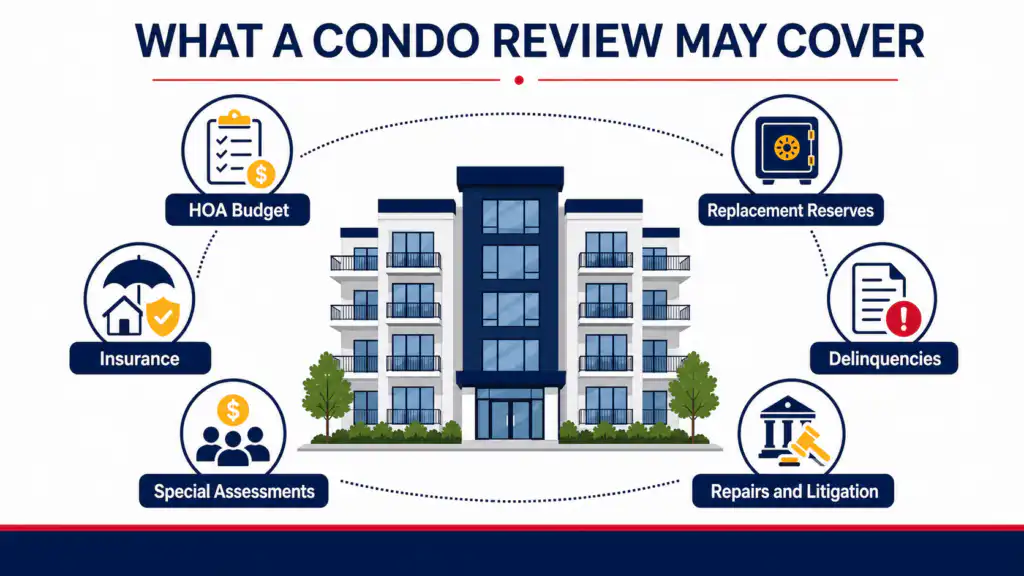
HOA Budget and Financial Health
The lender may review the current HOA budget to determine whether it reasonably supports the project’s operating expenses, insurance obligations, maintenance, and capital needs.
Low monthly dues are not always a sign of financial strength. If dues have been held below the level needed to maintain the property, owners may eventually face larger increases or special assessments.
Replacement Reserves
As of this article’s guideline verification date, Fannie Mae Full Review and Freddie Mac Established Condominium Project review generally require at least 10% of the applicable annual assessment income to be allocated to replacement reserves, unless an acceptable reserve study supports an alternative approach.
For applications dated or received on or after January 4, 2027, both agencies increase the standard minimum reserve allocation from 10% to 15%.
That 15% change does not take effect on August 3, 2026. Keeping the two effective dates separate is important.
Reserve Studies
Beginning August 3, 2026, when a lender relies on a reserve study, the project budget must fund the highest recommended reserve allocation in that study. The agencies no longer permit use of the baseline funding method for this purpose.
Freddie Mac also requires the reserve study used under its established project rules to meet detailed standards, generally including a component inventory, financial analysis, proposed funding plan, qualified independent preparer, and a current study or update dated within 36 months of the lender’s eligibility determination.
HOA Assessment Delinquencies
For the applicable full or established project review, both agencies generally limit the number of units that are 60 days or more delinquent on regular HOA assessments to no more than 15% of the total units.
They also generally apply a 15% limit to units that are 60 days or more delinquent on each special assessment.
Special Assessments
A special assessment does not automatically make a condo ineligible.
The lender may need to determine:
- Why the assessment was created
- Whether it is connected to a critical repair
- The original amount and remaining balance
- When collection is expected to be complete
- Whether the work is funded and progressing
- Whether owners are delinquent
Under Fannie Mae’s project condition rules, a project can remain ineligible when a special assessment is connected to an unresolved critical repair. The issue is not merely that an assessment exists. The purpose, funding, status, and underlying property condition matter.
Deferred Maintenance, Critical Repairs, and Safety
Projects with significant deferred maintenance, material deficiencies, unresolved structural concerns, or evacuation orders can be ineligible.
Fannie Mae identifies examples that may require closer review, including water intrusion, advanced deterioration, failed structural safety inspections, and certain unfunded repairs. Lenders may need HOA meeting minutes, engineering reports, inspection reports, reserve studies, repair lists, and special assessment documents.
The full standards are described in Fannie Mae Selling Guide B4 2.1 03 and Freddie Mac Guide Section 5701.3.
Litigation
Not all litigation makes a condo ineligible.
Litigation tied to safety, structural soundness, habitability, functional use, or significant financial risk can create an eligibility problem. Minor matters may be acceptable when they meet the agency’s requirements and the lender has documentation supporting the conclusion.
Master Insurance
The HOA master insurance policy must meet the applicable agency standards. The lender may review coverage, replacement cost support, deductibles, required perils, and whether the borrower needs a unit owner policy.
Insurance deserves early attention because a fully qualified buyer cannot correct an inadequate master policy alone. Resolution may require action by the HOA, management company, insurance agent, or carrier.
Other Project Characteristics
Depending on the project, the lender may also evaluate:
- Commercial or mixed-use space
- Hotel or transient use characteristics
- Short-term rental arrangements
- Single entity ownership concentration
- Shared amenities or mandatory memberships
- Project completion status
- Termination or insolvency proceedings
- Manufactured housing
What Documents May the Lender Request?
There is no single document package for every condo transaction. A lender may request some or all of the following:
- A completed condo project questionnaire
- The current HOA budget
- Master insurance evidence and policy information
- A reserve study, when applicable
- Special assessment notices and payment information
- Recent HOA board meeting minutes
- Engineering, structural, mechanical, or inspection reports
- Litigation information
- Documentation for major repairs
- The project’s legal name, address, and management company contact
Fannie Mae and Freddie Mac provide a standardized full condo questionnaire, commonly known as Fannie Mae Form 1076 or Freddie Mac Form 476. Use of the form itself is optional, but the lender remains responsible for obtaining enough reliable information to complete the required review. The agencies’ forms and resources are available through the Fannie Mae Condo, Co Op, and PUD Eligibility page.
Why Early Condo Review Matters in Colorado
Colorado has a wide range of condo properties. A small neighborhood project in Parker, a downtown Denver high-rise, an older building in Capitol Hill, and a mountain resort project can present very different review questions.
Older buildings may have larger capital needs. Urban projects may include commercial space. Mountain properties may raise questions about transient use, hotel characteristics, insurance, and specialized maintenance.
The goal is not to label a project before reviewing it. The goal is to identify the correct review path and uncover time-sensitive issues before they threaten a closing.
My Recommended Process for Buyers and Realtors
Before the Offer
Condo project review is one part of the broader mortgage loan process, but it deserves attention before the transaction gets too far.
Send the lender the property address, the MLS listing, and the legal condo project name if available.
Ask whether the lender sees any known project status or review issue. A preliminary check is not a final approval, but it can identify obvious concerns.
Immediately After Contract
Order the HOA documents and lender questionnaire promptly. Confirm the management company contact and any fee for completing the questionnaire.
Tell the lender immediately about any special assessment, pending repair, recent insurance change, litigation, or HOA disclosure.
During the Review
Keep the HOA, management company, Realtor, borrower, and lender communicating. A delayed response from one party can delay the entire review.
Avoid assuming that a prior sale in the project proves current eligibility. Project conditions, budgets, insurance policies, agency rules, and lender documentation can change.
Common Borrower Questions
Can my condo loan be denied even if I am preapproved?
Yes. A mortgage preapproval primarily evaluates the borrower. Condo financing may also require the project to meet agency and lender requirements. Strong income, credit, assets, and down payment do not override a project eligibility problem.
Does a special assessment automatically disqualify the condo?
No. The lender needs to understand the purpose, amount, payment status, delinquency level, and whether the assessment addresses a critical repair. A well-documented and adequately funded assessment may be acceptable. An unresolved critical repair can be a serious issue.
Will every condo require a Full Review after August 3, 2026?
No. Some loans and projects may qualify for Fannie Mae Waiver of Project Review, Freddie Mac Exempt From Review, Reciprocal Review, or another permitted path. Eligibility must be confirmed for the specific transaction.
Do the new rules apply if I applied before August 3, 2026?
Fannie Mae makes the retirement mandatory for loan applications dated on or after August 3, 2026. Freddie Mac makes it mandatory for mortgages with Application Received Dates on or after that date. Lenders may implement the changes earlier, so ask the lender which process applies.
Is the HOA required to put 15% into reserves beginning August 3, 2026?
No. The standard minimum increase from 10% to 15% applies to the relevant Fannie Mae and Freddie Mac project reviews for applications dated or received on or after January 4, 2027. The August 3, 2026 reserve change concerns how an acceptable reserve study is used.
Can a small condo project avoid Full Review?
Possibly. Fannie Mae expanded its waiver to certain projects with 10 units or fewer. Freddie Mac expanded Exempt From Review for certain projects with 2 to 10 units. Projects with 5 to 10 units generally cannot be part of a master association for these expanded paths.
If one lender says no, can another lender approve the project?
Sometimes the issue is a lender overlay, documentation approach, or review path. In other cases, the project does not meet an agency requirement that another conventional lender cannot simply ignore. A second opinion can be useful, but it should be based on the actual reason for the decision and the supporting project documents.
Does this change affect FHA and VA condo loans?
The August 3 changes discussed in this article concern Fannie Mae and Freddie Mac conventional financing. FHA and VA have separate condo approval and eligibility requirements.
Should I review the HOA documents even if the lender approves the project?
Yes. Mortgage eligibility is not the same as personal due diligence. Buyers should review the HOA documents with the appropriate real estate and legal professionals to understand dues, restrictions, assessments, insurance, reserves, repairs, and governance.
Are HOA dues included in my mortgage payment?
Usually not. The Consumer Financial Protection Bureau explains that condo or HOA dues are generally paid directly to the association and should be included in the buyer’s affordability planning. See the CFPB guidance on condo and HOA fees.
For more general financing guidance, visit my mortgage questions and answers.
The Bottom Line
The August 3, 2026 changes do not make every condo impossible to finance. They do make early project review more important.
For many transactions, the lender will need to understand both the borrower and the condominium project. That means more attention to the HOA budget, reserves, insurance, delinquencies, assessments, repairs, litigation, and project structure.
If you are a buyer, Realtor, financial planner, homeowner, or investor considering a condo, involve a mortgage professional before the transaction gets too far.
Ready to Review a Condo?
Buying or refinancing a condo?
Send us the property address, the MLS listing, and the legal condo project name before you write an offer or as soon as you go under contract. My team can help identify the likely review path, explain what documents may be needed, and surface potential financing issues early.
Schedule a mortgage strategy conversation or review the Cederholm Mortgage Advisors home purchase guide.
This article is for general educational purposes. Guidelines, lender requirements, project facts, and loan eligibility can change. A project review and loan approval must be completed for the specific transaction.