Discover how seller concessions and seller credits work. Learn what they cover, how to negotiate them, and the maximum limits for Conventional, FHA, VA, and USDA loans.

In today’s dynamic real estate market, negotiating a home purchase involves more than just agreeing on a sale price. If you’re a home buyer trying to keep your out-of-pocket expenses low, or a real estate agent looking for creative ways to hold a deal together, seller concessions (often called seller credits) are your best friend.
Whether you’re trying to cover closing costs or buy down an interest rate, understanding how to structure seller credits can make or break a transaction. Let’s dive into exactly what seller concessions are, what they can be used for, and the rules you need to follow based on the loan type.
Why seller credits matter in Colorado’s current market
Updated October 10, 2026, with August 2026 market context. Higher mortgage rates can make buyers hesitate, but negotiating the right purchase terms may help you move forward comfortably. The Colorado Association of REALTORS® September report describes slower demand and longer marketing times creating more leverage for buyers. Its Denver commentary reports concessions in 61% of August closings and price reductions in nearly 46%.
Now can be a good time to buy when the home fits your needs, your income is stable and the full payment fits your budget. Motivated sellers may consider a price reduction, seller-paid closing costs or an approved rate buydown—and sometimes a combination. Have your agent assess the specific listing’s time on market, condition and competing homes. Seller motivation varies, and the current market does not guarantee a discount on every property.
If rates fall later, more buyers could return and negotiating opportunities could change. You do not need to predict the market perfectly to make a good decision; you need a purchase that works today. Start with our Colorado guide to buying now or waiting.
What Are Seller Concessions?
Seller concessions are closing costs that the seller agrees to pay on behalf of the buyer. Instead of the buyer bringing the full amount of cash to the closing table, the seller essentially redirects a portion of their profit from the sale to cover some of the buyer’s expenses.
For the seller, it might seem counterintuitive to give money back. However, offering a seller credit is often a faster, more effective way to incentivize a buyer than dropping the listing price. For example, a fully usable $10,000 seller credit can reduce the buyer’s cash to close by $10,000. A $10,000 price reduction lowers the purchase price and generally the loan balance; its monthly savings depend on the down payment, rate and loan term.
What Can You Use Seller Concessions For?
Seller credits cannot be used for the buyer’s down payment, nor can the buyer walk away from closing with “cash in hand.” However, they can be used for almost all other transaction-related expenses.
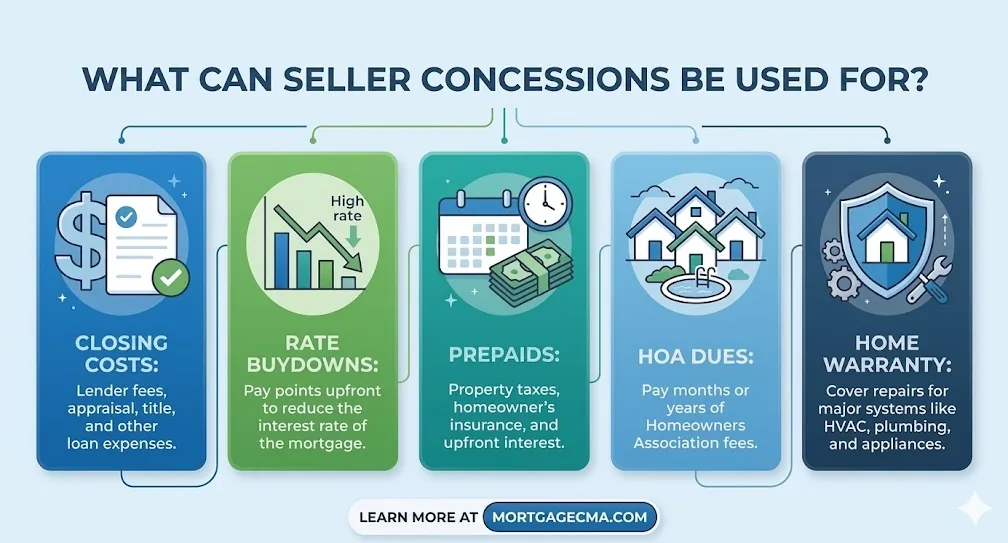
Here are the most common ways to use seller concessions:
- Closing Costs: Title insurance fees, appraisal fees, lender origination fees, and escrow fees.
- Rate Discount Points: Paying money upfront to permanently lower the interest rate on the mortgage.
- Temporary Rate Buydowns: Funding an eligible 2-1 or 3-2-1 buydown to reduce the buyer’s early payments through a prepaid subsidy; the contractual note rate remains unchanged.
- Prepaid Items: Funding the buyer’s escrow account for future property taxes and homeowners insurance.
- Upfront Homeowners Association (HOA) Dues: Covering eligible prepaid HOA dues when the loan program allows them; Fannie Mae permits up to 12 months of post-closing assessments.
- Home Warranty: Purchasing an eligible home warranty, subject to program rules and the warranty’s coverage and exclusions.
- Debt Payoff (VA Loans Only): Under specific VA loan guidelines, concessions can even be used to pay off the buyer’s consumer debt to help them qualify.
Three financing options to compare before asking for a seller credit
Temporary rate buydowns: help with early payments
An approved seller-funded 2-1 buydown subsidizes your principal-and-interest payment for two years: your portion is calculated at two percentage points below the note rate in year one and one point below it in year two. You pay the full note-rate payment starting in year three. A 1-0 or 3-2-1 buydown may be available on certain programs. The note rate itself remains unchanged, and the lender applies the program’s qualification rules. On Fannie Mae loans, you must qualify at the note rate. Review our 2-1 buydown guide and official Fannie Mae requirements.
Permanent rate buydowns: discount points paid at closing
Seller credits may pay approved discount points to secure a lower interest rate. On a fixed-rate mortgage, that rate stays in place for the life of that loan. One discount point costs 1% of the loan amount; the amount of rate reduction varies with the lender, product and current pricing. Compare the points cost, monthly savings and expected time in the loan. Seller-paid points still use credit you could allocate to other eligible costs, and an early refinance may shorten the benefit. Read the CFPB explanation of points.
ARM options: evaluate the initial savings and future payments
An ARM (adjustable-rate mortgage) may offer a lower starting rate than a comparable fixed-rate mortgage, depending on pricing. Seller credits may cover eligible closing costs or points if the specific ARM program allows them. An ARM’s introductory rate is a feature of the loan, separate from the seller credit, and paying points does not make an ARM permanently fixed.
Ask about the fixed introductory period, index, margin, adjustment schedule and first, subsequent and lifetime rate caps. Review the payment at the first possible increase and maximum permitted rate. Choose an ARM only if you are comfortable with the potential increases even if you cannot refinance or sell when planned. See the CFPB explanation of ARM rate caps.
For Home Buyers: How to Keep Cash in Your Pocket
Buying a home is expensive. Between the down payment, moving trucks, and new furniture, your savings can deplete quickly. Negotiating seller concessions is the smartest way to preserve your liquidity.
Pro Tip: Instead of asking the seller for a $5,000 price reduction, ask for $5,000 in seller credits. If the seller accepts and you have $5,000 of eligible costs, the credit can preserve $5,000 of your own savings for renovations or emergencies. A price reduction and credit may have a similar effect on the seller’s proceeds, but their net is not always identical because commissions and other costs can vary.
Talk to your loan officer at Cederholm Mortgage Advisors with Edge Home Finance early in the process. We can help you calculate exactly how much cash you’ll need to close and tell you the maximum seller credit you should ask for based on your specific loan program.
For Real Estate Agents: Using Credits to Save the Deal
As a Realtor, you know that keeping a deal together after a rough inspection can be challenging. Seller concessions are the ultimate problem-solving tool.
- Inspection Negotiations: Instead of forcing the seller to manage contractor repairs before closing (which can delay the timeline), negotiate a seller credit. This allows the buyer to hire their own contractors after closing and keeps the transaction moving.
- Marketing Stagnant Listings: If you have a listing that has been sitting on the market, don’t just drop the price. Advertise “Seller Offering $10,000 Toward Rate Buydown!” This directly targets the buyer’s biggest fear (high interest rates) and creates a more compelling marketing hook.
Maximum Seller Concession Limits by Loan Type
Lenders cap the amount of money a seller can contribute to prevent inflation of property values. It is critical to know these limits before writing the purchase contract.
Here is a quick cheat sheet for maximum seller contributions based on the property and loan type:
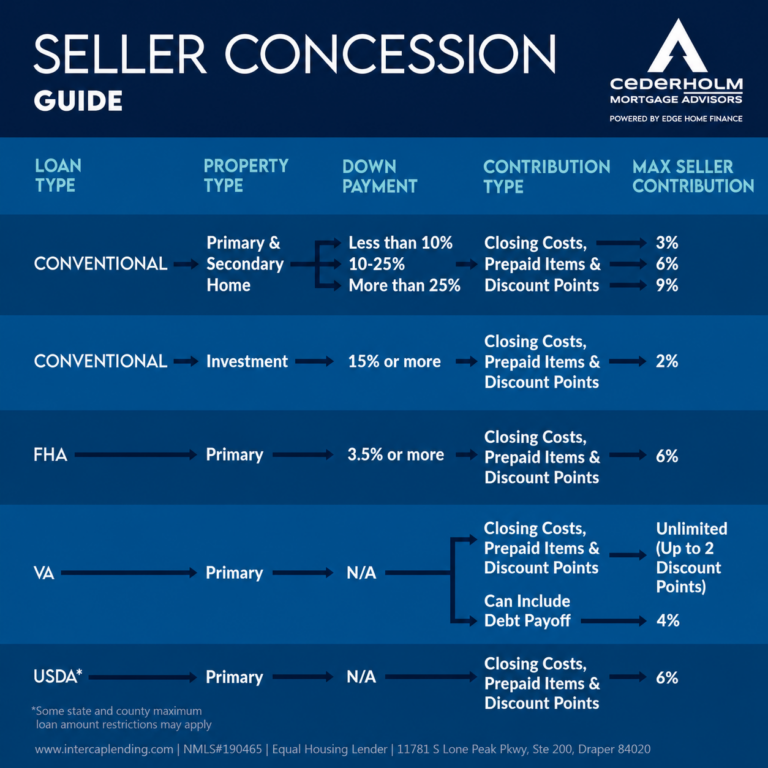
The illustration above is a quick overview. Use the program-specific table below: the calculation basis and VA treatment differ by program.
Seller concession limits: Conventional, FHA, VA, USDA, Jumbo and Non-QM
Use these program rules as a starting point. The lender must verify eligible expenses, occupancy, loan-to-value, other interested-party contributions and any stricter lender requirements. The percentage is a ceiling, not a promise that the seller will contribute that amount.
| Loan program | General seller contribution limit | What to verify |
|---|---|---|
| Conventional | Primary residence or second home: 3% above 90% LTV/CLTV; 6% from 75.01% to 90%; 9% at 75% or less. Investment property: 2%. | Fannie Mae bases these limits on the lower of sales price or appraised value. Contributions cannot exceed eligible buyer costs. Official conventional rules. |
| FHA | Up to 6% of the sales price. | For eligible origination fees, other closing costs, prepaid items and discount points. Excess contributions can affect the adjusted value used for underwriting. HUD Handbook 4000.1. |
| VA | VA-defined seller concessions: up to 4% of the property’s established reasonable value. | Ordinary buyer closing-cost payments and normal discount points are outside the 4% concession cap. Items such as the VA funding fee, prepaid taxes and insurance, debt payoff and some buydown arrangements require separate classification. Have the lender review the allocation. Official VA guidance. |
| USDA Guaranteed | Up to 6% of the sales price. | Contributions must fund eligible loan purposes, such as closing costs and prepaids. Confirm product-specific buydown eligibility. USDA origination FAQ. |
| Jumbo | Varies by lender and investor. | Confirm the cap, its calculation basis, occupancy rules and permitted points or buydowns for the exact loan. |
| Non-QM | Varies by lender and investor. | Confirm the specific product’s contribution limit, eligible costs, buydown availability and any prepayment penalty. |
Seller credits generally cannot fund your down payment or required reserves, and an unused credit does not become unrestricted cash back. Do not assume the conventional calculation basis applies to every program: FHA and USDA use sales price for these limits, while VA uses established reasonable value for its defined concessions. Jumbo and Non-QM rules must be checked with the lender.
How to size and negotiate a credit you can actually use
Ask Cederholm Mortgage Advisors for a current closing-cost estimate before writing your offer. Include eligible lender and settlement fees, prepaid interest, homeowners insurance premiums and initial escrow deposits for property taxes and insurance. A seller credit can pay approved prepaids at closing; it does not remove your responsibility for future tax and insurance bills.
Next, compare a price reduction, closing-cost credit, temporary buydown and permanent buydown on the same loan assumptions. You may negotiate both a lower price and a seller credit when the seller agrees and the appraisal supports the transaction. The combined request still needs to make sense for the seller and comply with your loan program.
Keep the requested credit within both the applicable program limit and the eligible expenses you can use it for. Credits for closing costs, prepaids, points and buydown funds generally draw from the same program allowance; VA separately classifies ordinary closing costs and defined concessions. Unused credit cannot become unrestricted cash back. Have the lender and agent review contract wording and any unused-credit adjustment before closing. Our seller concessions calculator can help you start the conversation.
Inspection credits require special care. A credit toward approved closing costs may preserve your own cash for later repairs, but it is not cash paid to you for renovations. Repairs required for safety, property eligibility or the appraisal may need to be completed before closing. Do not assume a seller credit replaces those requirements.
Buy comfortably today; revisit refinancing when the numbers make sense
You can negotiate a home and financing strategy now, then review refinancing options in the future if the terms support your goals. A refinance depends on future rates, your income and credit, home value, equity, program requirements and closing costs. It is an option to evaluate, not a guaranteed exit from a payment you cannot afford.
For a temporary buydown, be comfortable with the full note-rate payment after the subsidy ends. For an ARM, be comfortable with the permitted rate increases and the resulting payments. Include property taxes, homeowners insurance, mortgage insurance, HOA dues, maintenance and a cash reserve in your budget. You should feel comfortable with both the decision to buy and the payment you may need to carry without refinancing.
The opportunity is to negotiate a purchase that works for you today. A lower price, seller-paid closing costs or an approved buydown can make a meaningful difference when the home, budget and timing fit. Schedule a call with Paul Cederholm to compare the available structures before you make an offer.
Ready to Structure Your Winning Offer?
Understanding seller concessions gives you a massive advantage in any real estate market. Whether you want to buy down your interest rate or just bring less cash to closing, our team at Cederholm Mortgage Advisors is here to run the numbers.
Contact Cederholm Mortgage Advisors today to get pre-approved and learn exactly how much you can save with a strategic seller credit!
Helpful External References for Further Reading:
- Fannie Mae Guidelines on Interested Party Contributions (IPCs)
- HUD/FHA Seller Concession Guidelines
- VA Guidance: Closing Costs and Seller Concessions
For a detailed side-by-side purchase example, read our Colorado guide to seller concessions vs. a price reduction.