10 Effective Ways to Improve Your Credit Score Before Applying for a Mortgage
Before You Apply for a Mortgage, Your Credit Matters
If you are thinking about buying a home, your credit score matters. It is not the only thing a lender looks at, but it can have a real impact on your mortgage options, your interest rate, and how strong your overall loan approval looks.
The good news is that your credit score is not set in stone. With the right strategy, many buyers can improve their credit profile before applying for a mortgage. Sometimes the improvement is quick. Other times it takes a little patience. Either way, it is worth paying attention to before you start shopping for a home.
Here are 10 practical ways to strengthen your credit before applying for a mortgage.
Understanding Credit Scores
What is a Credit Score?
A credit score is a number lenders use to help evaluate how you have managed credit in the past. Most credit scores range from 300 to 850. In general, a higher score tells lenders you may be a lower-risk borrower.
Your score is based on the information in your credit report, including your payment history, balances, account age, credit mix, and recent credit activity.
myFICO Credit Score Factors
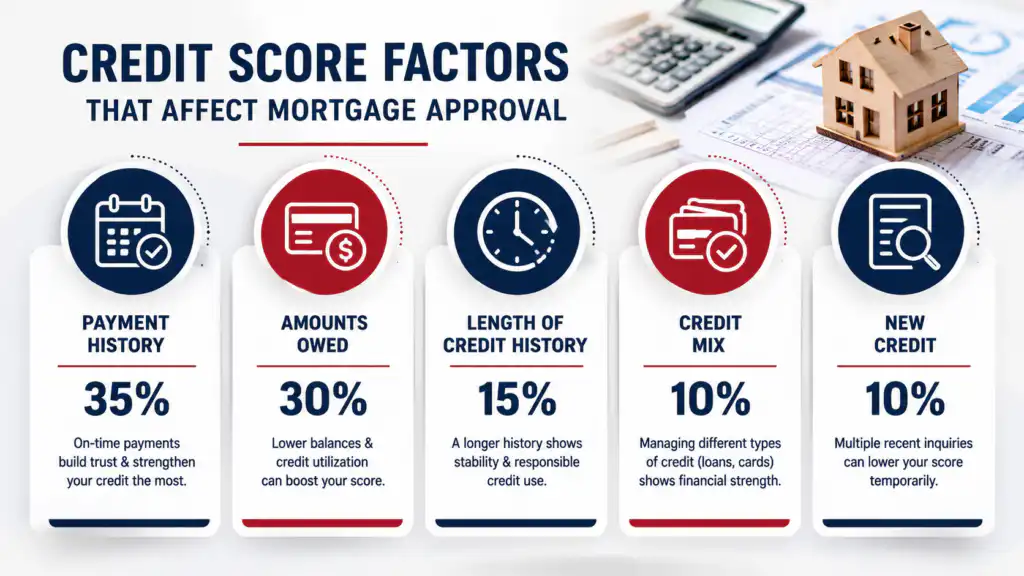
FICO scores are generally based on five main categories:
- Payment History (About 35% of your score): Paying bills on time matters more than anything else.
- Credit Utilization (About 30% of your score): This includes how much debt you carry and how much of your available credit you are using.
- Length of Credit History (About 15% of your score): Older, well-managed accounts can help.
- Types of Credit (About 10% of your score): Lenders like to see that you can responsibly manage different types of credit.
- New Credit Inquiries (About 10% of your score): Opening several new accounts in a short period can hurt your score.
How FICO Credit Scores are Calculated
For mortgage purposes, even a small credit score improvement can sometimes make a meaningful difference. It may help with pricing, loan options, mortgage insurance, or overall approval strength.
Importance of Credit Scores in Mortgage Applications
Credit scores play a pivotal role in mortgage applications. Lenders evaluate your score to assess the risk of lending to you. A higher score may qualify you for lower interest rates, which can save you thousands over the life of your loan. Conversely, a lower score might result in higher rates or even denial of your application.
Step 1: Check Your Credit Report First
How to Obtain Your Credit Report
Before you try to fix your credit, you need to know what is actually being reported. Start by reviewing your credit reports from Equifax, Experian, and TransUnion.
You can get your free credit reports from each of the three major credit bureaus: Equifax, Experian, and TransUnion by visiting AnnualCreditReport.com, which is the official site for free credit reports from the three major credit bureaus. It’s recommended to check your reports from all three bureaus to ensure comprehensive insight into your credit status.
What to Look For in Your Credit Report
When reviewing your credit report, pay close attention to the following:
- Personal Information: Ensure your name, address, and social security number are correct. Look for incorrect names, addresses, or personal information.
- Account Information: Check that all debts are accurately reported with correct balances. Look for accounts that do not belong to you.
- Payment History: Look for any late payments or delinquencies that may inaccurately reflect your credit behavior, or collections or charge-offs that may be reporting incorrectly.
- Inquiries: Note any hard inquiries that you do not recognize, as these may suggest unauthorized credit checks.
Do not assume your credit report is accurate just because it has been reporting that way for years. Mistakes happen, and they can cost you money when applying for a mortgage.
Step 2: Dispute Any Credit Report Errors
Common Errors Found in Credit Reports
Errors in credit reports are more common than many people realize. If you find errors, you can dispute them online or by writing to the credit bureau reporting the error. You can usually dispute online, by phone, or by mail.
When possible, include documentation. That may include bank statements, payment confirmations, letters from creditors, or account records showing why the item is incorrect.
Process for Disputing Errors
The Federal Trade Commission recommends disputing errors with both the credit bureau and the company that provided the incorrect information. You can review their guidance here: FTC Credit Report Dispute Guide.
Credit bureaus generally have 30 days to investigate a dispute, although some situations may allow additional time. If the error is corrected, they will send you an updated credit report.
Step 3: Pay Your Bills on Time
Impact of Late Payments on Credit Score
This sounds basic, but it is the biggest one. Payment history is the largest factor in your FICO score.
A late payment can stay on your credit report for seven years, and one recent late payment can make a mortgage approval more difficult. If you are preparing to buy a home, this is the time to protect your payment history aggressively.
Payment history is the most significant factor affecting your credit score. Late payments can remain on your report for up to seven years, making it crucial to pay your bills on time. A single missed payment can drop your score significantly, affecting your mortgage application.
Simple Ways to Avoid Late Payments
To ensure timely payments, consider setting up automatic payments for recurring bills. You can also use reminders on your phone or calendar to alert you of upcoming due dates. Additionally, creating a budget can help you manage your finances more effectively, ensuring you have sufficient funds available when bills are due.
- Set up automatic payments for minimum payments
- Add calendar reminders before due dates
- Pay bills a few days early instead of on the due date
- Keep a small cushion in your checking account when possible
The goal is simple: no new late payments before applying for a mortgage.
Step 4: Pay Down Credit Card Balances
Understanding Debt-to-Income Ratio
Your debt-to-income ratio, also called DTI, compares your monthly debt payments to your gross monthly income. Lenders use it to measure how much room you have in your budget for a mortgage payment. Lenders typically prefer a DTI ratio below 43% for the best rates, but depending on the loan type, it can be as high as 57%, but we don’t recommend pushing it that high. A lower DTI indicates that you have a manageable level of debt relative to your income, making you a more attractive candidate for a mortgage.
Credit card balances can have a major impact on your credit score because they affect your credit utilization ratio. That is the percentage of available revolving credit you are using.
Paying down debt can help in two ways. It may improve your credit score, and it may improve your mortgage qualifying strength
Debts to Review with your Mortgage Broker
- Credit card balances
- Auto loans
- Student loans
- Personal loans
- Installment loans
- Co-signed debts
Important Mortgage Tips:
Do not randomly pay off accounts without a plan. Sometimes paying down a credit card helps more than paying off an installment loan. The best move depends on your full mortgage picture.
Credit scores are usually based on the balance reported to the credit bureaus, not necessarily the balance you carry after making your payment. If you pay your card off after the statement closes, a high balance may still be reported. If you are trying to optimize your score, consider paying the balance down before the statement closing date.
Ways to Lower Your Debt
To lower your DTI, focus on paying down existing debts. Start with high-interest debts first, such as credit cards, to reduce the overall amount you owe more quickly. Additionally, consider ways to increase your income, such as taking on a side job or freelance work, to improve your DTI ratio.
Step 5: Manage Your Credit Utilization Ratio
What is Credit Utilization?
Credit utilization measures how much credit you are using compared to your total available credit. It is calculated by dividing your total credit card balances by your total credit limits. A lower utilization ratio (ideally below 30%) indicates responsible credit management.
For example, if you have a credit card with a $10,000 limit and a $5,000 balance, your utilization on that card is 50%.
Best Practices for Maintaining a Healthy Ratio
To maintain a healthy credit utilization ratio, consider the following strategies:
- Pay down existing balances to reduce your overall utilization.
- Request a credit limit increase from your credit card issuer, which can lower your utilization ratio if you maintain the same balance.
- Use multiple credit cards responsibly instead of maxing out a single card.
Step 6: Do Not Close Old Credit Cards Without a Good Reason
Benefits of Long-term Credit History
Closing an old credit card can sometimes hurt your score because it may reduce your available credit and eventually affect the age of your credit history.
That does not mean you should keep every card forever. If a card has a high annual fee or creates temptation to overspend, the decision may be different. But before closing accounts prior to a mortgage application, talk with a mortgage professional first.
Keeping old credit accounts open can positively impact your credit score by increasing the average age of your accounts. A longer credit history demonstrates to lenders that you have experience managing credit over time, making you less of a risk.
How to Maintain Old Accounts
Even if you are not using old credit accounts, it is advisable to keep them open to benefit your credit score. Consider using them for small purchases periodically and paying off the balance in full each month. This activity keeps the account active and contributes positively to your credit utilization ratio.
Step 7: Avoid Opening New Credit Before Applying
Impact of Hard Inquiries on Credit Score
When you apply for new credit, it can create a hard inquiry. New accounts can also lower the average age of your credit history and may increase your debt.
Before applying for a mortgage, avoid opening unnecessary credit cards, furniture financing, auto loans, personal loans, or buy now pay later accounts.
NOTE: This is especially important once you are under contract on a home. A new payment can affect your debt-to-income ratio and could create approval issues.
Best Practices for Managing Credit Applications
To manage credit inquiries effectively, space out applications for new credit. If you’re shopping for mortgage rates, try to do so within a short time frame, as credit scoring models often treat multiple inquiries in a 30-day period as a single inquiry. This strategy helps minimize the impact on your score.
Step 8: Become an Authorized User
How Being an Authorized User Works
When you become an authorized user on someone else’s credit card account, you gain access to their credit limit and payment history without being responsible for the payments. This arrangement can help improve your credit score if the primary account holder has a good payment history and low credit utilization.
Choosing the Right Account to Join
Choose a credit card account with a long history of on-time payments and low credit utilization. It’s essential to communicate with the primary account holder to ensure they maintain good credit habits, as any negative activity can also impact your score as an authorized user.

Step 9: Be Strategic When Shopping for Mortgage Rates
Rate is not everything, and there may be more than meets the eye
Shopping for a mortgage rate is smart. Chasing the lowest advertised rate without understanding the full loan structure is where buyers can get into trouble.
Rate is important, but it is not everything. A mortgage is not just a rate. It is the rate, lender fees, discount points, closing costs, loan program, mortgage insurance, underwriting guidelines, appraisal process, timing, communication, and the lender’s ability to actually get the loan closed.
Sometimes a lower rate comes with higher upfront costs. Sometimes it includes discount points that may not make sense unless you plan to keep the loan long enough to break even. Sometimes the “best rate” is attached to a loan structure that is not the best strategy for your financial goals.
That is why you want to compare real numbers, not just rate quotes.
Rate Shopping and Credit Inquiries
It is normal to compare mortgage options. Rate shopping is not the same as randomly applying for several types of credit with multiple lenders, and it can hurt your credit scores.
Credit scoring models often treat multiple mortgage inquiries within a focused shopping window as one inquiry for scoring purposes. That means you can compare lenders without each mortgage inquiry necessarily hurting you separately.
Still, do not drag the process out longer than needed. Be intentional, compare real numbers, and work with someone who can explain the full loan strategy, not just quote a rate.
Why Rate Is Not the Whole Story
Two lenders can quote the same rate and still have very different total costs. One may charge more in points or lender fees. Another may have stricter underwriting overlays. One may be better for FHA, VA, conventional, jumbo, self-employed borrowers, down payment assistance, or unique income situations.
The question is not just, “Who has the lowest rate?”
The better question is, “Which mortgage option gives me the best combination of payment, cost, approval strength, flexibility, and long-term financial benefit?”
A slightly lower rate does not help much if the loan has excessive fees, poor communication, delayed underwriting, or a structure that does not fit your goals. The right mortgage strategy should help you buy the home with confidence, understand your options clearly, and avoid surprises before closing.
Why Work With a Mortgage Broker Instead of a Retail Lender?
A retail lender usually offers its own loan products, pricing, guidelines, and internal underwriting rules. That can work for some borrowers, but it can also limit your options.
A mortgage broker works differently. A broker can compare multiple wholesale lenders, loan programs, pricing options, and guideline solutions to help find a mortgage strategy that fits your specific situation.
That matters because not every borrower fits neatly inside one lender’s box. Credit score, income type, down payment, property type, debt-to-income ratio, self-employment, VA eligibility, FHA needs, condo approvals, appraisal requirements, and closing timeline can all affect which lender or loan program makes the most sense.
Benefits of Using a Mortgage Broker
- More options: A broker can shop multiple lenders instead of being limited to one company’s rates and products.
- Better pricing: Wholesale lenders often compete for brokered loans, which may create stronger pricing opportunities depending on the scenario.
- More flexible guidelines and options: If one lender says no, another lender may have a different guideline or no overlay for the same situation.
- Loan strategy, not just a quote: A good broker compares the rate, payment, points, fees, cash to close, mortgage insurance, and long-term plan.
- Better fit for unique borrowers: Brokers can be especially helpful for self-employed borrowers, first-time buyers, VA buyers, FHA buyers, jumbo borrowers, and clients with layered scenarios.
- One point of contact: Instead of calling multiple lenders yourself, a broker can help compare options and explain the differences clearly.
- Problem solving: A strong broker knows how to structure a file, identify potential issues early, and match the borrower with the lender most likely to get the loan done correctly.
The goal is not just to find a low rate. The goal is to find the right mortgage strategy for your credit, income, budget, timeline, and long-term plans.
Choosing a loan officer based only on the lowest quoted rate during pre-approval can be a costly mistake.
Why? Because almost any loan officer can quote a low rate upfront. Unfortunately, some do it without clearly explaining the cost to get that rate, including discount points, lender fees, or other tradeoffs. On top of that, mortgage rates change constantly. The rate quoted today may not be available tomorrow, and sometimes rates move multiple times in the same day.
The better strategy is to choose the person you trust to guide you through the process, explain your options clearly, communicate proactively, and help you make the best overall financial decision, not just chase the lowest number on a quote.
Before deciding who to work with, ask yourself these three questions:
1. Do I trust this person to give me honest advice, even if it is not what I want to hear?
A good loan officer or mortgage broker should help you understand the full picture, including the rate, fees, payment, cash to close, loan structure, risks, and long-term strategy. You want someone who is willing to tell you the truth, not just say whatever sounds good to win the deal.
2. Do I feel comfortable asking questions and making financial decisions with this person?
Buying a home or refinancing a mortgage is a major financial decision. You should feel comfortable asking questions, slowing down when something is unclear, and getting explanations in plain English. If you feel rushed, confused, or pressured, that is a red flag.
3. Is this person communicating clearly and giving me the information I need to make a smart decision?
The right loan officer should be proactive, responsive, and clear. They should explain not only what your options are, but why one option may be better than another based on your goals, timeline, budget, credit, and overall financial situation.
The lowest rate quote does not always mean the best mortgage. The best mortgage is the one that gives you the right combination of rate, cost, payment, approval strength, communication, confidence, and long-term strategy.
When you work with a good mortgage broker, you get someone who can shop the market, compare real options, explain the tradeoffs, and help you make a confident decision instead of guessing based on a single advertised rate. A good mortgage broker will shop rates for you and compare loan programs and options, then present you with scenarios that work for your situation.
Step 10: Get Professional Guidance Before Making Big Credit Moves
When to Consult a Credit Counselor
Credit improvement is not one-size-fits-all. What helps one buyer may hurt another.
For example, paying off a collection, closing a card, opening a secured card, or disputing an account can all have different outcomes depending on the credit profile and the mortgage timeline.
If you are planning to buy a home in the next 3 to 12 months, it is smart to have your credit reviewed before making major moves. A mortgage professional can help you understand what matters most for qualifying, pricing, and timing.
Finding Reputable Credit Counseling Services
If you find it challenging to improve your credit score on your own or if you are experiencing financial difficulties, seeking help from a credit counselor may be beneficial. These professionals can provide personalized advice on budgeting, debt management, and credit improvement strategies.
If your situation is more serious, such as identity theft, multiple collections, or overwhelming debt, a reputable nonprofit credit counselor may also be worth considering.
When looking for credit counseling services, verify their credentials and ensure they are nonprofit organizations. Look for agencies accredited by the National Foundation for Credit Counseling (NFCC) or the Financial Counseling Association of America (FCAA). Read reviews and ask for referrals to ensure you receive quality assistance.
Final Thoughts
Improving your credit score before applying for a mortgage can put you in a stronger position as a homebuyer. You may qualify for better options, improve your approval strength, and potentially reduce your long-term borrowing costs.
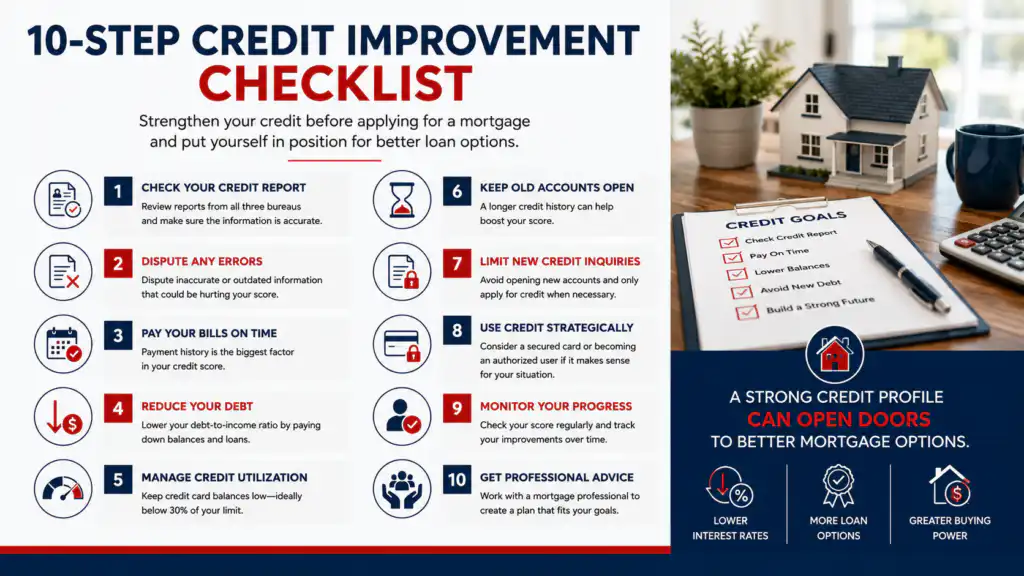
Start with the basics. Check your credit reports. Correct errors. Pay on time. Lower credit card balances. Avoid unnecessary new credit. Then get guidance before making any major credit decisions.
If you are thinking about buying a home in Colorado or want to understand where your credit stands before applying, we can help you review your mortgage options and build a smart plan before you start house hunting.
Need Help Reviewing Your Mortgage Readiness?
If you are planning to buy a home in Colorado, the smartest time to review your credit is before you start making offers. I can help you look at your mortgage options, review what may affect your approval, and build a plan that puts you in a stronger position.
Contact Paul Cederholm at Cederholm Mortgage Advisors to start your mortgage planning strategy.
FAQs
1. How long does it take to improve my credit score?
It depends on what is holding your score down. The time it takes to improve your credit score varies based on your individual circumstances. Some changes, like paying down credit card debt, can lead to immediate improvements, while others, like establishing a long credit history, take time.
2. Will checking my credit score hurt my score?
No, checking your own credit score is considered a soft inquiry and does not affect your credit score. However, hard inquiries from lenders do impact your score.
3. Can I improve my credit score without taking on new debt?
Yes, you can improve your score by paying off existing debts, making timely payments, and disputing errors on your credit report without taking on new credit obligations.
4. What is the minimum credit score needed for a mortgage?
The minimum credit score needed for a mortgage varies by loan type and lender, but generally, a score of 620 and above is recommended for conventional loans.
5. How frequently should I check my credit report?
You should check your credit report at least once a year. However, if you are actively working on improving your score, consider checking it more frequently to monitor your progress.
6. Can a mortgage broker help me understand what to improve?
Yes. A good mortgage lender or mortgage broker can review your credit, income, debts, and loan goals to help identify what may improve your approval strength before you apply.